Painting Your PVC Vinyl Fence? Read This First!

Quick answer: you technically can paint a PVC fence, but on quality product you shouldn’t need to and in almost every case you shouldn’t — the colour runs through the material so there’s nothing to “refresh”, paint struggles to stay bonded to PVC through Perth’s temperature swings, dark colours can physically damage the panels, and coatings generally put you outside your warranty. Nine times out of ten, the problem that prompted the question is solved by cleaning or a panel swap instead — and this guide covers all of it: the material science of why paint fails on this surface, the one scenario where painting is defensible and the professional method if you insist, the complete stain-by-stain restoration playbook we actually use, and how to make the paint-versus-replace decision with real numbers.
In this guide:
- Why PVC fencing is engineered to never need paint
- Why paint fails on PVC — the material science
- The warranty question, properly answered
- What’s actually wrong with your fence? The three scenarios
- Paint vs clean vs replace: the decision framework
- The complete restoration playbook, stain by stain
- If you’re painting anyway: the least-bad professional method
- Inherited a painted or yellowed PVC fence? Triage guide
- Frequently asked questions
Why is PVC fencing designed to never need paint?
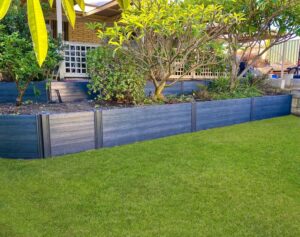
Because on a quality PVC fence there is no finish to maintain — the colour is the material itself, blended through the full thickness of the uPVC before it’s extruded, with the UV protection built into the same layer. This is the fundamental difference from every other fence you’ve owned. A timber fence is timber plus a paint skin; a Colorbond fence is steel plus a bonded coating; both have a surface layer whose job is to protect the substrate, and whose failure is the beginning of the fence’s decline. A PVC panel has no such layer. The white you see is pigment — primarily titanium dioxide, which conveniently doubles as the UV stabiliser — dispersed through the entire wall of the profile. Scratch it and you find more white. In premium product the sun-facing surface is co-extruded with an even TiO₂-richer cap stock, concentrating protection exactly where WA’s extreme UV hits.
This is the entire value proposition of the material, and it’s worth stating plainly before any painting discussion: timber owners are on a recoating subscription — every three to five years under WA sun, forever — and PVC owners opted out of that subscription at purchase. It’s why our PVC range carries a 30-year warranty: the “finish” being warranted is the material itself. Painting a PVC fence re-subscribes you to the exact maintenance cycle the product was engineered to eliminate, converts a warranted asset into an unwarranted one, and — as the next section explains — usually doesn’t even work for long. Sit with that before pricing primers.
Why does paint fail on PVC fencing?
Four mechanisms, all rooted in the material’s physics: paint can’t key into a non-porous surface, the panel moves more than a cured paint film can tolerate, dark colours overheat the substrate, and UV attacks the paint faster than it attacks the PVC underneath. Understanding them explains why painted vinyl so often looks worse than unpainted vinyl within two summers.
1. There is nothing for the paint to grip
Paint bonds to timber by soaking into grain and keying into a porous surface. PVC is smooth and non-porous by design — the same property that lets it wipe clean with soapy water gives paint almost no mechanical hold. A standard exterior acrylic sits on the surface like a decal. Specialist adhesion-promoting primers formulated for rigid plastics genuinely improve the bond, but “improved” is a long way from “permanent”, and the next two mechanisms attack even a perfectly primed coat.
2. The fence moves more than the paint does
Rigid PVC has a high coefficient of thermal expansion: in practical terms, a 2.4-metre rail grows and shrinks in the order of 6–8mm between a cold July morning and a 40-plus-degree February afternoon. The fence system is engineered around this — rails float inside routed posts rather than being screwed rigid, with specified expansion gaps, precisely so the material can breathe. A cured paint film is far less elastic than the panel it’s riding on. Cycle that mismatch through a few hundred Perth days and the film crazes along the stress lines, cracks, and starts lifting at edges and fixing points. This failure mode isn’t a workmanship risk you can prep your way out of; it’s built into the physics of two materials with different movement trying to occupy the same surface.
3. Dark colours cook the panel
White PVC reflects the bulk of the solar load that hits it — that’s part of the engineering. Paint the same panel charcoal and it starts absorbing that energy instead: dark exterior surfaces in direct WA sun can climb past 70°C, approaching the range where rigid PVC begins to lose stiffness. The results we’ve been called to inspect include bowed rails, rippled privacy infill, and panels that have crept out of their posts as the softened material moved beyond its expansion allowances. The US vinyl-siding industry, where painting vinyl is more established, evolved a rule of thumb worth borrowing verbatim: nothing darker than a Light Reflectance Value (LRV) of about 55 — a threshold that excludes essentially every fashionable dark grey on the current colour card. If your heart is set on a dark fence, the honest answer is a different fence: our Colorbond range does monument and charcoal properly, with a coating engineered for the steel beneath it.
4. The paint weathers faster than the fence
The final irony: the uPVC beneath your paint job carries a decades-grade UV package, while the paint film on top of it faces WA’s extreme UV index with ordinary exterior-coating chemistry. The fence would have outlasted the paint even if the paint had adhered perfectly — which, per mechanisms one and two, it won’t.
Does painting void a PVC fence warranty?
In most cases, yes — coatings and modifications are standard exclusions in fence warranties, because paint failure, moisture behaviour under a film, and dark-colour heat damage aren’t manufacturing faults, and no extruder can stand behind a surface they didn’t make. This isn’t a gotcha clause; it’s the manufacturer declining responsibility for a second product applied over theirs. The practical arithmetic is stark: painting a fence with twenty-five years of warranty remaining converts a warranted asset into an unwarranted one in a single afternoon, in exchange for a finish with a three-to-five-year life expectancy.
Before opening any tin: read your warranty wording specifically for coatings, surface treatments and modification clauses, and note whether the warranty is full-replacement or pro-rata and whether it transfers to a future owner (a selling point you’d be extinguishing). If you bought from us and you’re unsure, call first — 08 9450 1626 — it’s a two-minute conversation that can save a very expensive one later.
What’s actually wrong with your fence? The three scenarios behind the question
In nearly two decades of fencing across Perth and Bunbury, every “should I paint my PVC fence?” conversation traces to one of three situations — and painting is the wrong fix for two and a half of them.
Scenario one: it looks dirty, dull or stained (the overwhelming majority)
Red dust, general grime, mould in the shaded runs, green algae on the south side, and Perth’s signature — orange iron staining from bore-water reticulation. None of this is finish failure, because there is no finish to fail; it’s all sitting on the surface, and it all comes off. The complete stain-by-stain playbook is below, but the headline: twenty minutes with a hose and the right chemistry achieves what a weekend of painting would, at a hundredth of the cost, with zero warranty consequence.
Scenario two: a panel or section is damaged
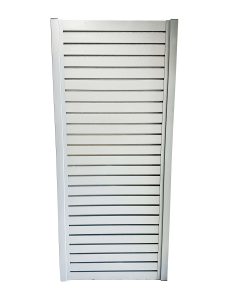
Cracked panel from an impact, gouged run beside the driveway, a rail that lost an argument with a trailer. Paint hides none of this well and repairs none of it at all. On a modular system the correct fix is component replacement: a complete 2,388mm full-privacy panel kit is currently $144.90 in our online store, picket panels from $134, posts $39. The swap typically costs less than quality primer and paint would have — and the result is new material, not disguised damage.
Scenario three: you’ve genuinely gone off the colour (the half-legitimate one)
If you bought white and now want the fence to recede into a dark landscape scheme, that’s a real design problem — but be clear-eyed about what painting signs you up for: an unwarranted fence, on a three-to-five-year recoat cycle, restricted to light colours anyway by the LRV-55 heat rule, which means you can’t even get the dark colour that motivated the project. Run that against progressively replacing the fence with the material that actually comes in your colour. The maths is closer than people expect, and only one path ends with the right fence.
Paint vs clean vs replace: the decision framework
| Your situation | Right move | Typical cost order | Result lifespan |
|---|---|---|---|
| Dirty, dusty, stained, mouldy | Clean (playbook below) | Under $50 in products | Repeat as needed; fence unaffected |
| Scuffed and marked | Clean — melamine sponge | Under $10 | Permanent (colour is through-material) |
| One or two damaged panels | Replace components | $134–$180 per panel; posts $39 | New material, warranty intact |
| Widespread damage / cheap fence failing | Re-fence (staged if needed) | Quoted; DIY from ~$80/m supply | 20–30+ yrs, 30-yr warranty |
| Want a light-colour change, accept the trade-offs | Paint — professional method below | Quality primer + vinyl-rated paint + labour | 3–5 yrs per coat cycle; warranty void |
| Want a dark colour | Different material — steel/aluminium | Quoted | As per material |
The complete restoration playbook: how to clean a PVC fence, stain by stain
Every common mark on a Perth PVC fence has a specific, cheap fix — and because the colour runs through the material, removing the mark reveals fence, not undercoat. This is the section to bookmark; it solves the problem that brought most readers here.
General grime and red dust: hose down, then warm water with dishwashing liquid and a soft-bristle broom or microfibre cloth, working top to bottom, panel by panel. Rinse. Done once or twice a year, this is the entire maintenance schedule of a PVC fence, and it keeps the fence looking close to new indefinitely.
Scuff marks — mower bumps, bike pedals, soccer balls, wheelie-bin rash: a melamine sponge (“magic eraser”) with light pressure lifts them cleanly. No touch-up paint exists or is needed; the white beneath the scuff is the same white.
Orange bore-water iron staining — the most-asked-about mark on white fences across Perth: dissolved iron in bore reticulation oxidises on whatever it lands on, and a white fence displays it like a billboard. It looks alarming and is completely superficial. Apply an oxalic-acid based iron stain remover per the product directions, let it work, rinse thoroughly — the transformation is usually immediate. Then fix the cause: re-aim the sprinkler throw so the fence is out of the spray line, or the stain returns on the next watering cycle. (Same treatment works on limestone and rendered walls while you’ve got the bottle out.)
Mould and algae in shaded runs: a diluted white-vinegar solution for routine growth, or a very dilute household bleach solution for established colonies, applied with a soft brush, dwell a few minutes, rinse well. South-facing runs and sections behind dense planting will always regrow first; improving airflow and trimming vegetation off the fence slows the cycle. Never mix vinegar and bleach.
Sap, adhesive residue and marker: start with the melamine sponge; escalate to isopropyl alcohol on a cloth, tested first on a hidden section. Stop there — see the warnings below before reaching for anything stronger.
What to avoid, and why: acetone, thinners and aggressive solvents can attack and permanently dull the surface; abrasive scourers and cutting compounds scratch a finish that otherwise never scratches visibly; and high-pressure washing at close range can drive water into joints and scar the material — if you must use a pressure washer, wide fan tip, low pressure, arm’s length. The governing rule: if hose, soap, melamine and the correct stain chemistry won’t shift a mark, component replacement is almost always the better answer than escalating the chemistry.
If you’re going to paint anyway: the least-bad professional method
We’d rather you didn’t — but an informed job beats a doomed one. With every caveat above still attached, this is the method that gives paint its best chance on rigid PVC:
- 1. Wash to bare-surface clean. Sugar soap or a TSP substitute, full rinse, completely dry. Paint applied over chalk, grime or mould is applied to a release layer, and the job is over before it starts.
- 2. Scuff — don’t sand through. A light abrade with a fine synthetic pad gives the primer micro-texture to hold. Aggressive sanding cuts into the TiO₂-rich surface layer, damaging the very UV protection you’ll be relying on around the paint’s inevitable failures.
- 3. Prime with an adhesion-promoting primer rated for rigid plastics. This is the step DIY jobs skip and the step that decides everything. Ordinary acrylic undercoat is not this product.
- 4. Top-coat with a premium 100% acrylic exterior — ideally a urethane-modified acrylic marketed for vinyl or plastics — in light colours only (LRV above ~55). Two thin coats beat one thick one; thick films crack sooner under thermal movement.
- 5. Set expectations in writing to yourself: even executed perfectly, plan on visible wear and a recoat within three to five Perth summers, a voided warranty from the first coat, and the knowledge that every future owner of the fence inherits the cycle.
Inherited a painted or yellowed PVC fence? The triage guide
Bought a place with someone else’s decisions on the boundary? Here’s how to assess what’s salvageable.
Previously painted, now peeling: the hardest position, honestly. Removing failed paint from PVC without damaging the surface is slow, careful work — plastic scrapers, patience, isopropyl on residue, never heat guns or aggressive strippers, which damage the substrate. On lightly painted sections it’s achievable; on heavily coated or sun-baked sections, panel-by-panel replacement is frequently more economical than restoration, and the modular system makes that a real option rather than a rebuild. Send us photos and we’ll give you a straight section-by-section assessment.
Yellowed or chalking: a diagnostic, not a stain. Yellowing is photo-oxidation — the surface of an under-stabilised vinyl breaking down under UV — and it tells you the fence’s formulation, not its cleanliness. Run a finger across it: if it comes away white and powdery, the surface is chalking and the material is announcing its end-game. Paint adheres even worse to a degraded surface than a sound one, so coating a yellowed fence buys its worst years a costume. Budget for staged replacement instead — and this time apply the quality tests in our complete honest assessment of PVC fencing, because modern properly stabilised product simply doesn’t do this.
Buying new? Choose the colour once, properly
If you’ve landed here while researching a fence you haven’t bought yet, the takeaway is simple: PVC rewards choosing a style and colour you’ll be happy with long-term, because the fence will hold that finish for decades without help. White and light neutrals are the material’s home ground — the reason it owns the picket, Hamptons and coastal-privacy looks — and if your palette runs dark, we’ll steer you to steel or aluminium without a hard feeling. Browse the PVC fencing range, or DIY supply from around $80 per metre if you’re handy on the tools.
Frequently asked questions
What’s the best paint for a PVC fence?
If you’ve read the above and are proceeding anyway: an adhesion-promoting primer rated for rigid plastics, top-coated with a premium 100% acrylic (ideally urethane-modified, marketed for vinyl), in a colour with an LRV above ~55. But the genuinely best “paint” for a PVC fence is none — the material outperforms any coating you can put on it.
Can you spray paint a PVC fence?
Spray changes the applicator, not the physics — adhesion, thermal movement, heat and warranty exclusions all still apply. Vinyl-rated spray products exist for small repairs on other products; for a fence-scale surface the honest advice stands: clean it or replace the component.
How long does paint last on a PVC fence?
With professional prep and vinyl-rated products, plan on visible wear within three to five Perth summers; with a standard DIY approach, often under two. The unpainted panel beneath is warranted for 30 years. That comparison is the whole argument in one line.
Can you stain PVC like timber?
No — stains work by penetrating timber grain, and PVC is non-porous. There is nothing for a stain to enter, which is the same property that makes the fence wipe-clean.
Can I paint just the gate or one section to test?
You can, and the test will teach you mechanisms one and two within a couple of summers — but note the warranty position applies from the first painted component, and a two-tone fence during the test period is its own problem. If the goal is assessing a colour change, a sample panel off the fence is a cheaper classroom.
My white fence has gone orange near the sprinklers — is it ruined?
Not remotely. That’s bore-water iron staining, Perth’s most common white-fence complaint. An oxalic-acid based iron remover takes it off in one treatment, and re-aiming the reticulation keeps it off. No painting involved.
Will pressure washing damage a PVC fence?
At close range and high pressure, it can — driven water in joints and scarring on the surface. If you use one: wide fan tip, moderate pressure, a metre back. A hose and soft broom achieve the same result with zero risk, which is why it’s what we recommend.
Does painting a PVC fence add value when selling?
It subtracts it: buyers’ inspectors increasingly recognise painted PVC as a maintenance liability and a voided warranty, where an original-finish fence with a transferable warranty is a selling point. If the fence looks tired before sale, clean it — the before-and-after from the restoration playbook above is the cheapest street-appeal win on the property.
Talk to the team that installs it
Team Work Fencing has supplied and installed PVC fencing across Perth, Bunbury and the South West since 2008. Replacement panels, a restoration plan for a tired fence, a section-by-section verdict on an inherited paint job, or a straight answer before you do something irreversible with a paintbrush — call 08 9450 1626 or request a free quote.
Let us make a recommendation for you.
Receive a No Obligation quote on PVC Fencing Prices today!